My photo
Healdsburg, California, United States
Grad school wasn't for me, so I took my masters and ran home. I eventually took a job in wine retail, cultivating my passion for everything wine related. Now, less than a year later, I'm working my first crush, at Williams Selyem in the Russian River Valley.

Wednesday, October 20, 2010

Interlude: Half-Way There

I apologize for the sparse posts, but when I have time to myself, I elect to spend it sleeping or eating. There's not much time or energy for anything else. The rumors are true, folks. Harvest is an all-consuming experience.

Just to say that I've posted more than one post in the month of Octobere two scenes from the winery these days.


Figure 1. [video removed] The Williams Seylem Harvest Crew supports their
winemaker, Phil, by performing their new theme fr digging tanks:
"Diggin' on a Prayer

Figure 2. My employee allocation: 12 bottles, discounted 50%.


Figure 3. The mix-'n-mingle part of the 2010 Harvest Party for winery
employees, growers, and guests. Location: the brand new Estate facility.


Figure 4. A gigantic live oak growing over/around a boulder, as seen
on the walk to the patio, where we had our fabulous meal.


Figure 5. A magnum of '93 Allen. It was excellent. Still had plenty
of good fruit (ripe red berries), but awesome depth and complexity
from the extended aging. There's still plenty of life left in that wine.


Figure 6. The 6L bottle signed by the Williams Selyem staff, presented
to the evening's guests of honor, Burt and Jan Williams. Seeing as the
winery wouldn't exist today without the key support in the 80s from
vineyard owner Joe Rochioli, the bottle is appropriately full of 2007 (an
outstanding vintage) Rochioli Riverblock.


Figure 7. The gorgeous engraving of the brand new Estate facility.
Top signatures are those of the Dysons (winery owners), and
Bob Cabral, executive winemaker.


Figure 8. The view from my seat at the dinner table: Estate vineyards.


Figure 9. Left to right: magnums of 2004 Bacigalupi Zinfandel
and 1993 Allen Pinot noir. Yum.


Figure 10. Fancy menu.


Figure 11. A stunningly vibrant bottle, considering its age. The 1998 Hirsch
(seriously Sonoma Coast) tasted so young that it could have passed for a 2008.


Figure 12. The Heavyweights' table. Visible: Burt Williams (left, facing right),
John Dyson (blue shirt, far end of table). Behind the waitress: Joe Rochioli.


Figure 13. A glass of 2006 late harvest gewurztraminer. Incredible with
(or as) dessert, it tasted like honeyed figs sprinkled with roasted nuts.


Figure 14. The view from the Estate's patio, facing south.


Figure 15. Another view of the gnarly live oak, with the Estate
building behind it.


Figure 16. Estate vineyard, facing east.


Figure 17. Newly planted vines in the Estate vineyard, facing southwest.


Figure 18. I took more liberties with the label maker, branding
the ferm container with a name stripped from a painfully 80s pop band.


Wednesday, October 6, 2010

Culture Club: An Update

In case you were wondering and hadn't already noticed, harvest is very time consuming. Just exactly how time consuming is harvest? My last paycheck was for 115 hours over a period of two weeks, during which I had a single day off. Some days were shorter than others, but the longest ones were about 12 hours. At a winery, that's pretty rough.

My schedule now goes something like this: wake up at 5:30; be at the winery and working by 7:00; spend the morning inoculating tanks and building yeast/malolactic cultures; break for lunch and whackbat at noon; work in the laboratory or build more cultures as needed, until 5 or 6. The lab work isn't nearly as exhausting as the culture stuff, since lab work doesn't involve running around with 5-gallon buckets of juice/wine for five hours at a time. The lab drains a person in its own special ways, though, such as running enzymatic analysis (post-press malic acid and residual sugar content) on 25+ samples at the same time, in a room that's between 80 and 85 degrees.

All the work is paying off, however. At the end of this week, we'll be between 85 and 90 percent through with crushing fruit. All the Russian River Pinot is in, as is much of the Chardonnay. Most of the Sonoma Coast Pinot is in. All the Central Coast Pinot is in. All we're waiting on at this point is some Russian River Chard, the port varietals, and the tiny quantity of Zin that we're getting this year (all of 4 tons, from what I hear). It's been a brutal vintage for Zinfandel here. The severe cold-weather pruning left the grapes exposed and vulnerable to sunburn and raisining during the heat spike, resulting in massive crop losses. Being the sticklers for quality that Williams Seylem are, this translates to tiny (or no) shipments of high quality grapes from affected vineyards.

Whenever the rest of the grapes come in, though, I'll just keep doing what I'm doing. Fruit comes in on Day Zero, gets crushed on Day One, cold soaks in its own juice until Day Five, and is then inoculated (by yours truly... mostly) with yeast from a culture that was grown on Day Three. When it's almost done fermenting, I pitch in a malolactic bacteria culture (prepared when fermentation really gets cookin'). And speaking of fermentations, check this out:

Figure 1. A fermentation tank with some very happy yeast.
There's plenty of wine underneath the cap, which is itself a good
eight or twelve inches below the layer of foamy goodness.

In other news, today was Headband Day at the winery. The trend, started by intern John, has become an official weekly event. Of course, being a cog in a well-oiled machine such as Williams Selyem's harvest crew, I had to participate.

Figure 2. Headband made of blue masking tape. Also notice
the 7am glaze over the eyes, the need-another-day-off bags
underneath them.

Hopefully my senses will return to me when things slow down after crush, when the daily routine becomes more about monitoring malic acid, VA, and sulfur levels in the newly vinted/barreled wines--as opposed to hauling two 50-pound buckets o' juice around for hours on end. Senses will be key for that work, as it will involve much barrel climbing, something you should never do with anything less than a sound mind. Much like handling blue masking tape, which should never be handled by a sleep deprived man on Headband Day.

Ever.

Monday, September 27, 2010

Interlude: Internship Images

I just finished my 7th consecutive day of work, with days averaging about between 10 and 11 hours. I'm tired. Physically and mentally. It looks like I'll have a day off on either Wednesday or Thursday. I just don't have the concentration or energy at this point to write an entry, not until I have a day off. So, in lieu of a post, here are some random images from the last week.


Figure 1. There is an ongoing competition to see who can "dig out"
a fermentation tank the fastest. As you can see, the stakes are high.
This shit is real.


Figure 2. Super Harvest Moon setting below the hills of the
Russian River Valley, along Westside Road, just west of Healdsburg.


Figure 3. Fruit being dumped into a fermentation tank. After it's all
in there (between 10 and 20 bins like this one), it's raked flat, covered
with dry ice pellets and a tarp, and left to sit for several days before
fermentation is started, so as to extract good color.


Figure 4. The view from atop a tank that I was gassing with argon gas
(to displace oxygen). That's the Allen vineyard, source of some great Pinot.


Figure 5. Another view from atop the same tank. Those are all
fermentation tanks. The platform there is actually on wheels, so it
can roll over any tanks on that side of the fermentation pad, to make
punchdowns easier on us interns.


Figure 6. Filling barrels in the cellar, post-press. This is wine, folks.


Figure 7. An enormous slug! Found it oozing around the entrance
to the fermentation room. I moved it to safety.


Figure 8. Some kind of really pretty moth that I found.

Monday, September 20, 2010

Run, GMC

Have you ever shown up to a place, announced your name, and then been immediately handed a nickname? For example, I showed up at Williams Selyem, and within a day or so of everyone knowing my name, one of them--The Reverend--proclaimed that he would thereafter refer to me as Bombay, in omaggio to the greatest youth hockey coach of all time. In a matter of days, that name morphed into Sapphire, which I still hear on occasion. Now, though, things have taken a sharp turn. Through a tangled web of esoteric monikers, I've most recently been dubbed GMC. That is, Guest Mad Chemist. This name arises from the Williams Selyem crew's name for my mentor, Patrick. Excuse me, I mean Mad Chemist "MC" Inoculator. I came to be known on Saturday as GMC, when MC (or, more formally, The Inoculator) had the day off.

So it was that young grasshopper was handed the reigns of power and responsibility for the second time this harvest season.

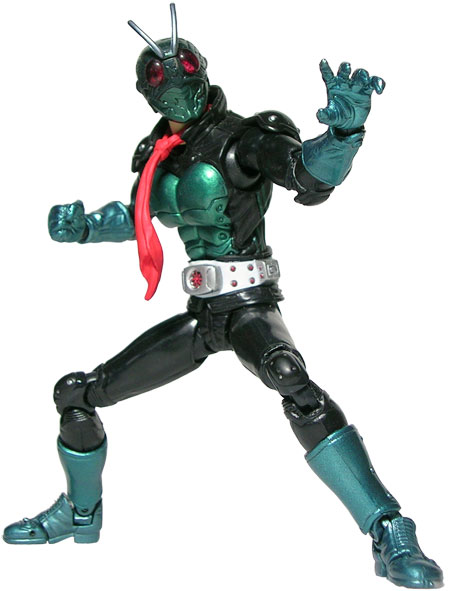
Figure 1. Some sort of freaky grasshopper superhero thing.
Or maybe it's a super villain? I don't know. Posting this
seemed like a good idea at the time.

Anyway, the point is, I was on my own for Saturday. As GMC, I was responsible for the usual stuff: processing vineyard samples (sugar and acid analyses), growing yeast cultures (for inoculating juice with, to begin fermentation), checking yeast culture health, and, of course inoculating juice with yeast. Now, that's enough work to keep a couple of people busy throughout a day. They'll be especially manic when the boss wants all of it done by lunchtime, per usual. Saturday, however, was very short-staffed, so the midday deadline only applied to vineyard sample analyses and inoculations. The sample deadline is for the boss's convenience, so that decisions about grape picking can be made faster. The inoculations, however, really do have to be done before lunch. Actually, they should be done before 11am, because that's when midday punchdowns occur. And, yes, let me explain the concept of punchdowns before I go any further.

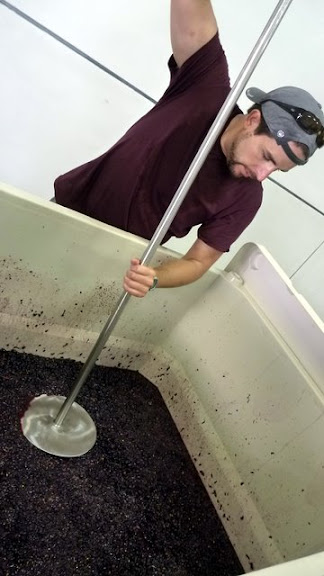
When fermenting wines are left in contact with grape skins, the skins will float to the top of the juice/wine. After sitting for a while, they form a hard, dense layer atop the liquid. This is known as the "cap". Since color and tannin are extracted from the skins and into the liquid, contact between them is crucial. So, as to ensure sufficient contact/extraction, the cap must be pushed down into the liquid on a regular basis, either by physical force, or by pumping juice from the bottom of the tank onto the cap. We do this several times per day at Williams Selyem, and all by manual force--absolutely no pumps are allowed to touch the juice/wine at any time during production.

Figure 2. A man performing a cap punchdown.

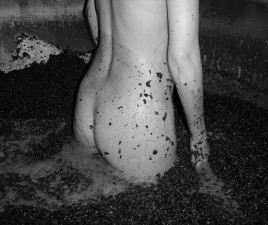
There are a couple variations on the manual punchdown, though. Above is the more common, handheld method, which is absolutely exhausting. There are also pneumatic devices which do the exact same thing, but require more intense mental focus than physical exertion. If you want to be very traditional--"naked" if you will--in your winemaking practices, then you could always take this route:

Figure 3. "Naked" winemaking taken to its literal end.
See this link for a quasi-explanation of this
personal/public/pubic health tragedy.

But[t] I digress. Again, while vineyard samples are processed before lunchtime for reasons regarding quicker management and decision making, yeast inoculations are completed before punchdowns for logistical reasons. Insofar as I can tell, it's just so the punchdown crew (which takes up a lot of space on the fermentation pad, where all the tanks are located) can do their work without maneuvering around some guy pitching yeast culture into tanks.


Figure 4. A tank of Pinot noir grapes/juice that I had just
inoculated with yeast culture. The scale is sort of hard to
discern here, but if I had to guess, I'd say that the length of
tank visible in this photo is about five or six feet. In this
tank is somewhere between 3 and 5 tons of fruit.

There are a bunch of small logistical concerns associated with this work. For example, keeping track of what buckets have held which juice, and whether or not that juice was inoculated with yeast already. If it was, you'd better clean it damn well before using it with some non-inoculated juice, or else you could accidentally start a fermentation on a tank that isn't ready for it. Painter's tape and Sharpies are your best friends here, great for making labels in a pinch. (If you hadn't pieced it together already, cleanliness and attention to detail are necessities when making fine wine.) Since I'm still finding my rhythm with this stuff, inoculations and yeast culture build-ups can take me a little while. But I think I've got a pretty good system so far, one in which I'm capable of inoculating two tanks on my own in a little less than an hour. Because of the time crunch and having to do the inoculations on my own, it was a very tiring morning. I was running back and forth from the fermentation room (where we keep all the yeast cultures) to the tanks of fruit, all the while carrying buckets full of yeasty juice or equipment. It made for a hell of a workout.

Figure 5. Me, in the fermentation room, filling a bucket with
yeast culture, with which to inoculate a tank of fruit.

The inoculations took all morning. In the afternoon, I had to do some yeast culture build-ups, which entails just adding more juice to the cultures, along with some nutrients for the yeast. That's easy work that just requires following some directions, making some simple calculations, and trying to not spill anything (because cleaning the ferm room sucks). That should only have taken about two hours, but thanks to various tasks that needed attending to, it ended up taking until about 5:30. All in all, it ended up nearly being another 11-hour day.

But you know what? I still like coming to work in the morning. The only limiting factor to how long I can be there is comfort. 10 hours of running around playing GMC can really wear a dude out. If my feet and energy level could handle it, though, I'd probably be there until midnight each and every day.

Tuesday, September 14, 2010

Interlude: Hans Brix

Today, in addition to doing lab work, sorting grapes, and pressure washing the fermentation pad, I also took some liberties with the label maker. Behold! Hans Brix, handheld refractometer! (It measures degrees brix. Har har.)

Figure 1. Hans Brix.

If this makes absolutely zero sense to you, click here.

The Sorting Table

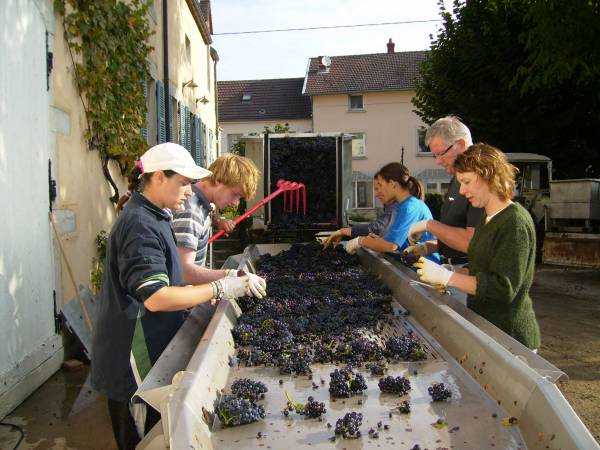
Regardless of the winemaking techniques one might employ, no matter what fancy equipment one might use, and certainly despite all the care and respect one may have for the juice, excellent wine can only be made from excellent fruit. That's the harsh reality of it. You can't make good wine from bad grapes. That'd be like trying to make ice cream from skim milk, or a butterfly from an Alot. So how--even in a stellar vintage--do you ensure that the grapes going into the wine are going to be consistently as top-notch as they can be? Like this:

Figure 1. A standard sorting table.

The instructions are simple. As the grapes go by, just remove anything that isn't a grape or a stem. This includes (but is certainly not limited to) leaves, raisins, underripe grapes, botrytized (moldy) bunches, and (whether you want to hear it or not) bugs. (I saved three spiders today from a cold, juicy death.) At first, the work is very demanding of attention. You have to really focus on the grapes, decide what you will and will not allow to roll past, and then act--all rather quickly. I think the conveyor was moving at about 3 inches per second, or a foot every four seconds. That's a pretty good pace. It ain't the "rabbit" on your lawnmower, but it sure ain't the "turtle", either.

After a while, the work does become routine. Your brain starts to relax, and your eyes and hands do the work on their own. You would probably think that these circumstances would be prime for zoning out, for getting a mental breather in, especially after a morning full of high-speed laboratory analysis. That's what I assumed, at least.

Boy, was I wrong.

As it turns out--when you're working at a sorting table for two straight hours, getting no breaks longer than the 15-seconds between bins of fruit being dumped onto the conveyor, understanding absolutely zero of the conversation between your other 5 line workers (middle-aged Mexican women)--your mind wanders. A lot. In the span of those two hours, I had more ideas, insights, and internal dialogs than I've probably had in the last week. At times, I felt like I was high. For example, this thought occurred to me around hour 1.5: This table is such a good metaphor for the arrow of Time, all moving in one direction 'n shit. Or, even better than that one: This table is such a good metaphor for eugenics, all creating a better result by weeding out the weak 'n shit. Alright, maybe that's not so much "high" thinking as it is "hair-brained literary'". But a lot of literature is conceived while high. So.

The most profound thought I had (not to imply that the previous two were) was the realization that, by being on sorting duty, I was as directly involved in the process of making wine as I will probably ever be at Williams Selyem. Sure, determining accurate sugar and acid content in samples is important. Yes, proper yeast culture build-up and inoculation is key. But those are just manipulations of the grapes. By deciding what grapes do or do not make it into the wine, I am directly responsible for the potential that the wine has. I help determine the upper limit of quality. I am both the Gatekeeper and the Keymaster for salvaging an off-vintage, as well as making a good one great.

Figure 2. Gatekeeper (left) and Keymaster (right).

When you think about it, that's some serious responsibility. Not only are the customers going to notice if the final product tastes strange (raisiny, green, etc.), but it affects the company and its reputation. It also affects me. After all, I'm here to make the best damn wines that I possibly can, and to learn how to make them. It'd be nothing short of cognitive dissonance to hold those motivations and not do the best that I could at the sorting table, recognizing the importance of that job.

Therefor, for two hours after lunch today, I sorted grapes like a goddamn champion.

After that, though, I was given the task of pressure washing the entire fermentation pad, so as to prevent the fruit flies and bees from swarming. If I learned anything today, it was this: I pressure wash like a goddamn champion of special needs. Embarrassing as it is to admit it, I suck at pressure washing grape skins and stems from a concrete floor into a drain. Believe it or not (and I have it on good authority that you should), it would actually have taken me less time to pick up every single grape skin individually--with my fingers--than to use a pressure washer. Here's hoping that they don't assign that job to me again.

Figure 3. No pressure washing for Gordon.

Saturday, September 11, 2010

First Solo Flight

"It takes a lot of beer to make wine."
- Every winemaker ever
It's so true. So very, very true. After a long, hard-fought day at a winery--moving heavy objects across an estate, cleaning them, moving them back again, repeating the sequence, making sure yeast and malo cultures are alive and well, processing/analyzing vineyard samples, analyzing juice/fermentation samples, and playing a midday cricket game--what beverage do you think winemakers/interns turn to for relaxation, rejuvenation, and gaseous regurgitation? Yup. Beer. It's delicious, it's bubbly, and it's cold. And it contains smaller quantities of alcohol than wine, so you can drink more cold, bubbly, tasty stuff before it hits you. Really, when you get right down to it, it's the perfect relaxation beverage for the working man.

Figure 1. Ommegang Abbey Ale, served in a goblet glass,
perfect for releasing the abbey ale's rich aromas, as well as
handling its traditionally massive head.

Goblet glass in hand (well, on the table, readily available to me), I can now relax and recount the events of my first solo flight. That is to say: I ran the laboratory on my own today, since my mentor had the day off.

My first day working solo in the lab was (by design) just more of the same, really. More vineyard samples came in, so I ran the usual Brix (sugar), pH, and TA (titratable acids) on them. I checked the malic acid levels on the malolactic culture. I set up a cork trial. I helped grow the yeast culture so that it will be ready to pitch into some Pinot juice starting tomorrow. The usual. Really, once I found my bearings this morning (bright and early at 7:00), it was smooth sailing. All these procedures are burned into my mind at this point. The only trick is not zoning out and relying on autopilot; therein the errors lie. If I keep my focus on the task at hand (however familiar), and make sure I have something to do at any given minute (have to wait while a sample reacts? Time to clean glassware!), then I'm set.

That's really all there is to report today. I did the usual stuff, but on my own for the first time. And no mistakes were made! ... That I know of, or that really matter, since the numbers all worked out today.

Thursday, September 9, 2010

Heat Spike, Cricket, and Yeast

You know what the funny thing about weather is? Trick question. There is no funny thing about weather, especially when it does one thing for an entire summer, then turns around 180° and does the exact opposite--and feels that hot, too.

As I've mentioned in previous posts, this has been the coolest summer here in nearly half a century. Which has been okay. Sure, the fruit has taken forever to ripen. But at least it's been ripening! Sure, the vineyard managers had to trim the leaves back super-far on the vines. But it's made up for the lack of warmth on the bunches! Sure, we winery workers have been bored on our asses for a while. But we've made do! Now what's happened? A heat spike. A nasty fuckin' heat spike. How bad? Well, I was taken into a neighboring winery's vineyard on Saturday, after the 100° day, and was shown some severe raisining on their vines. Whole bunches had turned from fat-and-juicy to lean-and-dry in a matter of hours. Hot, dry hours. But such is farming, I suppose. Feast or famine.

Figure 1. Raisined grapes.

Some of our vineyards made out similarly. Some of them were less severely affected. Some of them were hardly affected at all, and their fruit still looks great. It's a mixed bag. What this means for the winemakers is, in a nutshell, grief. And some painful decisions. What do you do in a situation like this? Do you pick? Do you hope for the best and leave the fruit on the vines?

As you can probably guess, it's complicated.

For the vineyards that looks healthy enough to continue ripening on the vines, they will do so. Unless we are threatened with another heat spike; then we will pick them, regardless of how underripe they may be. For the vineyards who are suffering from raisining, we will determine whether or not they can be risked leaving on the vines. If they can hold out, great; we will just employ liberal sorting practices when the fruit comes into winery, disposing of sunburned berries/bunches, leaving whatever good fruit is left to become wine. For the vineyards whose fruit is really suffering, we'll pick them early. The sugars will be a little lower than desired, and the acids will be slightly higher, but we'll manage.

If there's one thing I'd like to say about all this, it's: "quantity will suffer before quality will." Williams Selyem puts the quality of their wines above all else, especially profits. Not to sound like a [limited liability] corporate parrot here, but they understand the importance of putting long-term reputation above short-term income in the priority rankings. So they'll just do the best they can this year and suck it up. Rather, we'll just do the best we can this year, and suck it up. That said, the wines will be good. Some of them will likely be very good. Hell, the Chardonnays are coming along nicely, sunburns be damned. But I doubt anything will be stellar. Hopefully, I'm wrong there. We won't know until the wines have been in barrel for a while. At this point, it's still just speculation.

Anyway, moving on to happier things! For example, look what I can play!

Figure 2. Cricket: the most boring, most thrilling, most confusing game
that I've learned how to play since Magic: the Gathering.

Apparently, at Williams Selyem, the lunch breaks go something like this: eat your food quickly, then assemble teams and play cricket for the duration of lunch hour. And, boy, is that a hell of a lunch hour. Today's teams were divided accordingly: Americans (we down-home chumps) v. Foreigners (all representing former British Empire nations). Who do you think trounced who?

Seriously, though. Have you ever played cricket? Have you ever watched cricket? The came is utterly insane. How many innings are there? Two. Two?! Yes, two. How long do games usually run? Well, it depends. If it's a sound and swift beating, it could only last an hour. If it's evenly matched, or if one team is dominating so unrelentingly that their batters never get out, then the games could last for days. For days. Also, you have to pitch the ball with your arm completely straight. Absolutely zero bending at the elbow is allowed. Seriously. It really fucks with your rotator cuff. And, if you're batting, you can apparently hit the ball in any which direction you like. I don't know if the Aussies were just screwing with my head on that rule, but they claim that it's totally legal to hit the ball in whatever direction you so please--including backwards. Hey, you know what game cricket kinda reminds me of?

Figure 3. Whackbat, from The Fantastic Mr. Fox. If you haven't seen it,
I highly recommend that you do so. It was really incredible, and hilarious.

I realize that this is backward, since whackbat is just Roald Dahl's way of poking fun at cricket, but his pokes struck right on the mark. There were several moments today where the opposing team would cheer and rejoice, and I had to turn to somebody for an explanation--not just unaware of what had just happened, but unaware that anything had happened. Cripes, what a weird game.

After lunch and whackbat, I helped maintain the malolactic yeast culture that we have going (and will continue to have going throughout the harvest). This means checking its temperature (should be around 70°F), checking its sugar and acid levels, and pouring in nutrients. This is where you have to be careful, though. Fermentation produces a lot of CO2. When you open a take filled with fermenting juice, a lot of it escapes, and it displaces a lot of oxygen in the immediate area. Really, all you have to do is turn your head away, take a deep breath, and hold it in while working with the tank. If you were clumsy (and I do mean clumsy) enough to fall into the tank, or into an empty tank that was just drained of fermenting juice, then you'd likely be totally boned. That is, dead. Quickly. From asphyxiation.

Oh, and if you're curious about what I did over my 5-day weekend, courtesy of a late-starting harvest, here's a very abbreviated list of things that were on my itinerary: a seminar-style tasting at Joseph Phelps Vineyards (where I tasted 2006 Insignia, 2007 Insignia, and 2007 Backus, among others), a tour/tasting at Hendry, a tour/tasting at Chasseur (at which I picked up a few bottles; viva la industry discount!), and a great day at Taste of Sonoma (at which I met up with some old friends, and made some new ones!).

The holiday weekend is over, though (finally), and now it's back to the wine mines. I'm slated to work all weekend, with Monday off (I think?). But that suits me just fine. I've got no better place to be. And that's saying a lot, considering the paradise that surrounds me.

Friday, September 3, 2010

Week Two Round-Up

So much for the daily posts. For the time being, anyway. To be honest, there's only so much preparation a winery can do before fruit arrives. Is all the equipment cleaned? Yup. Are the crush pad, barrel rooms, and cellar cleaned? Affirmative. Are the monthly barrel analyses on last vintage's wines completed? They are. Has the juice for the sparkling wine been analyzed, and have the crushed grapes been disposed of properly? Yes to both.

Oh, that reminds me: We crushed our first batch of fruit this week!

It was exciting to see our first grapes come in, on Tuesday I think it was. About 6 tons of Pinot noir, for use as a sparkling wine base. We gently pressed the grapes, then transferred the juice into a chilled tank, so that there would be no skin contact. (Remember, we want a sparkling white wine from these grapes, a blanc de noir. Skin contact would make it pink.) The juice will stay in the tank, undergo fermentation (we will inoculate it with yeast), and then send it to a small operation in the area that specializes in secondary fermentations, since we just don't have the equipment for that type of stuff. They will take our wine, bottle it with added sugar and yeast, monitor it throughout its fermentation (as a little more alcohol and a lot of carbon dioxide are produced), and then finish it off by removing the yeast/sediment and plugging the bottle with a cork. In the end, we get this back:

Figure 1. Williams Selyem blanc de noir. It's delicious.

I should mention, though, that when I say that "we" pressed the grapes, and then "we" transferred the juice, what I really mean is: "the other interns" pressed the grapes, then "the other interns" transferred the juice. I was busy in the lab running analyses on the vineyard samples. Hey, how else will Bob know when to call in the fruit-picking army? Those acid and sugar levels don't reveal themselves without the help of a lab monkey. I'm not too jealous of the crush crew, though. Sure, they get to play with the fruit, moving, sorting, crushing, and (on the sly) tasting, but I'll get my chance. Right now, I've got to make sure the numbers are satisfactory. And as the grapes race toward the finish line of ripeness at the blazing speed of a stoned tortoise, my job is becoming very important. Vineyard samples will start coming in more frequently in the next week and a half, which means more to do. Exciting times!

On the social scene, the interns have definitely been gelling as a group and as a team. Apparently, this doesn't always happen. Some of my coworkers were recalling brutal harvest seasons, working with people who didn't get along, didn't want to get along, and were generally unpleasant people. I'm very glad that the 2010 Williams Selyem crew is nothing like that. When, at the end of a long day, you can all go hang out at someone's house and down some beers, sip some wine, listen to some music, and just chill, that's a pretty good group to be working with. Apparently, the early-arriving (June) interns found a place up in Dry Creek Valley (land o' great Zin), about 20 or minutes from the winery, called the Dry Creek General Store. It's a nice little shop, with a very Puckett's-esque restaurant inside. And, most importatly, it has a bar. But not just "a bar". The bar (that is, the long wooden installation on which brewskies are served) is fuckin' old. The DCGS bar is still the original, sitting in that location since pre-Civil War days. Just imagine the things that bar as seen. Imagine how many bets have been made, won, and lost there. Imagine how many wine industry deals have gone down there. The fights. The deaths. The conceptions, or perhaps even the births. Here, check this place out:

Figure 2. The DCGS. The bar is on the far left.

You know what the real appeal is, though, to a Tennessee native? Barbecue. Excellent barbecue. On Thursdays, they have all-you-can-eat barbecue, cooked right in front of the bar. It. Is. Glorious. Their wet-style ribs are just as good as any I've had in any part of the South. Really great stuff, especially after a long day at a winery. I think this will become a staple of Thursdays. It's too good to pass up.

So that was Week Two, in a nutshell. Due to all the cleaning being done, and the grapes being not yet ready for picking, the winery has resorted to scheduling interns. I have today and Tuesday off, and am on call Wednesday. That translates to a 4- or potentially 5-day weekend. I'm exhausted, though, so I'm just going to hang around here, I think. Lots of ready to do. And resting up for the coming insanity is a good idea, too. We'll see what happens.

Monday, August 30, 2010

Day Six: Vineyard Sampling

Today, I tasted the wines of tomorrow, in two different senses. In the literal sense, I tasted the 2009 Zinfandels while running analyses on barrel samples. They're coming along great! A couple of them have some good, strong tannins (but not harsh by any means), while others are big, peppery, spicy jam bombs. I think the 2009 Zins will be quite a treat. Hmm... I wonder if I could use my internship position to secure a place on the mailing list.
In the more figurative sense, the interns were all taken out to the Estate vineyard to collect bunch samples. We were taken among the vines and showed how to snip bunches as randomly as possible, so we can get an accurate representation of how the fruit is ripening. While we were out there, we picked a couple of berries and performed the ol' taste test. To confirm my answer to my dad's question: yes, the grapes are very sweet. They don't taste like the wines that they eventually become, because most of the flavors and tannins come from the skins. To get those compounds into the juice, you have to crush the grapes and then let the skins stew in the juice, so that the color and flavor are extracted into the juice. This process is called maceration. So, a ripe berry picked right off the bunch and popped into your mouth will taste surprisingly similar to a regular table grape, just a lot sweeter. Tasting is also a good way to check what's known as "phenolic ripeness" in the grapes. Phenolic ripeness refers to the chemical state of the tannins and phenolic compounds, which are responsible for color and flavor. The way you test for phenolic ripeness is by checking the colors of the stems and seeds. The browner they are, the riper the grapes; the greener, the less ripe.

After we collected the bunches, we took them back to the winery and crushed them up, collected the juice, and ran some tests on it to see how far along the ripening process is. At the Estate vineyard, it looks like we're about 80% there with the sugars (which become alcohol in fermentation). The acids were a little high, but we're not too concerned about that. The stems and seeds were still green, so phenolic ripeness is slow, but it'll get there. The grapes just need more time. Luckily, the forecast is for more heat and sunshine, with no rain in sight, so they can just take their time.

While I'm on the subject of ripeness, I may as well talk a little about vineyard management as pertaining to ripeness and vine/grape health. Ideally, a vineyard manager would want all the grapes to ripen at the same time, so that you can pick them all at the perfect moment: not overripe, not underripe. Unfortunately, in practice, that's rarely going to be the case without some work. When whole clusters don't ripen (stay green), or a second crop of fruit comes in late in the vintage (it happens), you just have to snip 'em off. Being on the vines, they suck up nutrients from the other, riper grapes. This stage of pruning is known as "green dropping". If, on the other hand, you've only got a couple green grapes on an otherwise gorgeous, ripe cluster, though, you just pick them off the bunch as it rolls by on the sorting table during crush. Pretty simple. At the end of the vintage, when harvest is near, here's what you want your vines to look like:

Figure 1. Grapes nearly ready for picking. No green bunches!

Anywho, after analyzing the vineyard samples, I went back into the lab and set up another cork trial (wineries go through a lot of corks, and every lot has to be tested!). After that, the rest of the day was spent finishing up monthly barrel sample analysis. If my (and Patrick's) calculations are correct, then Williams Selyem's 2009s are doing just fine. And thanks to my little taste test on the Zins, I can guarantee their fine-ness.

Sunday, August 29, 2010

Interlude: Days Gone Bye

If I were to begin a post with a phrase like, "I don't want to get too philosophical here, but," then that would imply that philosophy is, to some degree, inappropriate or ill-fitted for this blog. That's not to say that it is, but my intentions here are to keep this an informative, entertaining, and educational read about my internship here at Williams Selyem, and not necessarily a diary. But a few things do come to mind that I would like to share in this forum.

For example: I don't want to get too philosophical here, but a thought occurred to me during Friday's BBQ that I would like to share. I had just poured myself a glass of wine, walked over to the railing at the edge of the patio, and was checking out the view. It was something like this, but was in reality far more grand and sweeping in scope:

Figure 1. A typical Russian River Valley scene. Just imagine
this as a panorama.

The view was stretched around me, the sun was setting behind me, there were 50 bottles of ultra premium wine open on a table and at my disposal, and I was surrounded by people with whom I work (even if only temporarily) at a job that we are all passionate about and love doing. Seems to good to be true, right? No shit. I was in a sort of cinematic daze. You know, that sort of transcendental state when you're both the main character and cameraman in your own life? As I stood there at the railing, glass of something great in hand, I took in the view from both first- and third-person.

That's when the thought occurred to me: it felt like the credits should be rolling.

If someone were to make a biopic out of the last two years of my life, that's exactly what would have happened at that BBQ. The credits would have rolled. Act One: I was miserable and unsuccessful in graduate school. Act Two: I decide to take my master's. Act Three: I move back home and take a year to collect myself. Act Four: I decide to stop looking for chemistry jobs and start looking for wine jobs. Act Five: I am offered and accept an internship at Williams Selyem, where I ultimately arrive and am very happy to work at. Credits roll. Okay, maybe the more appropriate close to that dramatization would be "curtain," but you get the idea. It's the end of the story, right? It had the classic fairy tale ending, didn't it? Unless my life ended at that BBQ, the answer is hells no. And if it did, I'm easily the cleanest, best smelling, most civilized zombie in undead lore.

Speaking of zombies, that brings me to the thrust of this post. In the introduction to the first collected edition of his excellent comic, The Walking Dead, Robert Kirkman says:
"For me the worst part of every zombie movie is the end. I always want to know what happens next. Even when all the characters die at the end... I just want it to keep going. More often than not zombie movies feel like a slice of a person's life shown until whoever is in charge of the movie gets bored. So we get to know the character, they have an adventure and then, BOOM, as soon as things start getting good... those pesky credits start rolling."
We all know a good story that we feel this way about. A lot of people who read this blog feel that way about the Hitchhiker's Guide universe. (Although, the final book was apparently just released, allowing for some closure regarding the story.) Anyway, that's how I felt about my life in that moment, standing at the railing at the BBQ. I'm just a character (albeit, the central one) in my universe, and I have just finished an adventure. But! I have begun a new adventure. At some point, that one will end, too. Then I will begin a new one, and so on, until la Commedia รจ finita. That's what I presume, at least.

The point is, the best is yet to come. The introduction has closed, and the real adventure is beginning. Bilbo has returned home a rich little hobbit, but his adoptive nephew Frodo is about to embark on an even more fantastic journey. At the risk of sounding too devoutly Campbellian, I'll put it this way. We don't compare our lives to those of the Heroes; we are the Heroes. My journey just happens to wind its way through some vineyards. Where does it go from here? Who can say? I've got a pocket full of free will, sure, but I'm also just walking the mythic road. And I'll continue to, until those credits roll.

Saturday, August 28, 2010

Day Five: Wine Pong

I know you know how Friday ended. I put it in the title. But let me enlighten you as to how Friday began: with coffee.

I was in the barrel room at 7am on Friday, collecting samples. Once I'd collected them, I took them back to the lab, where Patrick and I ran sulfur and volatile acid (VA) analyses. They're simple enough experiments, fit for a General Chemistry lab class. Allow me to briefly explain. Sulfur is a key weapon in the fight against microbial growth in wine. Only small quantities are required, so you'll never detect it. However, if the sulfur content is too low, it's ineffective as an antimicrobial agent. If it's too high, the wine will be noticeably sulfurous. That's why it's important to monitor sulfur levels in the wine until it's bottled. The experiment is simple. In wine, sulfur is present in ionic form, as sulfites and bisulfites. When you add a huge amount of acid (such as 25% phosphoric acid) to the wine, the sulfur is released from solution as sulfur dioxide gas. This gas is collected and bubbled through a peroxide solution with a colored indicator, where it reacts to form sulfates and bisulfates. Titrate that solution with sodium hydroxide until the indicator changes color, and:

Figure 1. BAM! You know the wine's sulfur content.

VAs are even easier, since there's not really any reaction until the titration. You just boil a sample of wine in an enclosed chamber, collect the vapors (acids from the wine that have boiled off) after they've run through a condenser and become liquid again, and then titrate (See Figure 1).

So the lab work is pretty easy, and doesn't take too long per sample. We were pressed for time Friday morning, though, so we only ran a few. After that, I had to go back over to the winery's original lab and set up a cork trial. What is a cork trial, you ask? It's when we test a small sample of corks from a manufacturer's lot, to see if it's contaminated with trichloroanisole (TCA). Also known as "cork taint", TCA is the product of a mold that's found in the bark of cork trees. It smells like moldy cardboard, and (needless to say) it is extremely nasty. Tiny quantities can ruin an otherwise perfectly good wine, so it's very important to minimize its presence in the corks that we plug Williams Selyem bottles with--especially considering our tiny production. All wineries that are serious about quality run cork trials. They're also pretty easy to set up. You just let the corks (usually about 50) soak in glasses of wine (cheap, shitty boxed wine, since it doesn't have a cork) for a day or so, then pour the wine and sniff it. If you smell TCA, don't buy the lot of corks that that sample was from. If not, go ahead and order them.

After I set up the cork trial, I headed back over to the estate lab. Patrick told me that I needed to take some samples to an independent laboratory up in Healdsburg. This is also normal in the industry. Some tests just can't (or won't) be run by wineries, so they'll send out samples for analysis. Anyway, I got to drop some off downtown.

When I got back to the estate, however, the time for lab work was over. The time to drink had come.

As I mentioned earlier in the week, Friday we were scheduled to taste the entire 2008 line from Williams Selyem, to get a good idea of what they do. What do they do, you ask? Their whole philosophy is to produce wines in a minimalistic style, manipulating the juice/wine as little as possible, so that the specific nature of the fruit, soil, weather, everything--the terroir--comes through in the finished product. And, I gotta say, after tasting 15 single vineyard Pinots (that is, 15 bottles, each made with grapes from only a single vineyard), they succeed in their goal.

I won't go into details or give tasting notes (email me if you want them) on the various wines, but I will say this: terroir is a real and taste-able concept. For example, a Pinot from one vineyard along Westside road might taste very different from another from just down the road, despite being the same clone of Pinot and being vinted in exactly the same manner. What's different, then? Could be a lot of things: soil type, altitude, sun exposure, nearness to the Russian River (fog territory), etc. That was what the 2008 tasting drove home to me, that you really can "put a vineyard in a bottle". Williams Selyem does an excellent job at doing just that. Now, whether or not you're a fan of this style of Pinot is another thing entirely. For those who want the more traditionally made "Burgundian" style, they'll have to cough up some cash. While the regional blends (great deals) are around the $40-$50 range (when purchased from the winery), the single vineyards start at about $40 and jump well into the triple digits. Whether or not you want to drop that kind of cash on a bottle of wine is, again, your call. I'm very glad to get 50% off a case of wine while I'm here. That will make good drinkin' a lot more affordable.

After the tasting, the interns and winery staff headed out to the patio to enjoy a night of hanging out, awesome BBQ, and some stupendous wines. All the bottles from the 2008 tasting were brought out for consumption, as well as some very special bottles that people brought along. Bob (Cabral, the winemaker) brought a Riesling that was given to him by a former intern, whose family owns a winery in Germany. Some cheeky asshole brought a 2005 Kosta Browne single vineyard Pinot. (For those not in the know, Kosta Brown is kinda viewed as Williams Selyem's "rival" ultra premium Pinot maker. I wouldn't go that far, but there's market competition for sure.) To be honest, the Kosta Browne was hideous. I couldn't even drink it, just spit it out. It burned like a fruit-flavored cough syrup that was on fire in my mouth. Come to think of it, it was exactly like this:

Figure 2. The Flaming Moe. Secret ingredient: Colonel Krusty's Cough Syrup.

The biggest treats of the evening were two bottles that Bob (I think) also brought along. First was a late 90s ('97 or '98) Olivier Leflaive Grand Cru Burgundy. For those who aren't familiar with Burgundian vineyard class designation, that's a Pinot noir from one of Burgundy's highest ranked vineyards. It was okay, but a lot of the fruit had faded, and it was heavily Bretty. The star of the night was the 1988 Chateau Lynch-Bages (traditional Bordeaux blend). It was also just okay. 1988 must have been a cool/wet year, as it tasted very "green" and underdeveloped. There was virtually no fruit left, just a lot of earth tones and tannins. It was definitely cool to try, though.
When things eventually wrapped up with the BBQ, most of the staff headed home, leaving the interns essentially unattended with some tables, some red cups, and about 50 bottles of wine. Hmm... What do you think happened next? Let me give you a hint:

Figure 3. BAM! Drink!

Yup. Wine pong. But not just any wine pong: wine pong with mixed Williams Selyem single vineyard Pinots in the red cups. It was probably the single most expensive game of drinking pong ever. And you know what the real sacrilege was? My team lost. You know what that means? It means my team had to drink a whole lotta wine. Seeing as I was driving that night, I did what any sane winery employee would do: I spit. Let this be a lesson, folks. Whenever you're playing beer/wine/margarita pong, always save that one precious rerack for when it's absolutely necessary. Don't squander it early on. It will doom you to drink large quantities of liquids from red cups.

So that about wraps up my first week at Williams Selyem. It's been a blast so far, and I can't wait for fruit to start coming in so that we're actually making wine. The people I work with are great, and all love what they do. Nobody complains about their jobs, because they want to be there. Many of them (like myself) left jobs that they didn't enjoy to work in wine. Man, let me just say: there's something to be said about being surrounded by people who love their job. It's a contagious state of mind.