Regardless of the winemaking techniques one might employ, no matter what fancy equipment one might use, and certainly despite all the care and respect one may have for the juice, excellent wine can only be made from excellent fruit. That's the harsh reality of it. You can't make good wine from bad grapes. That'd be like trying to make ice cream from skim milk, or a butterfly from an
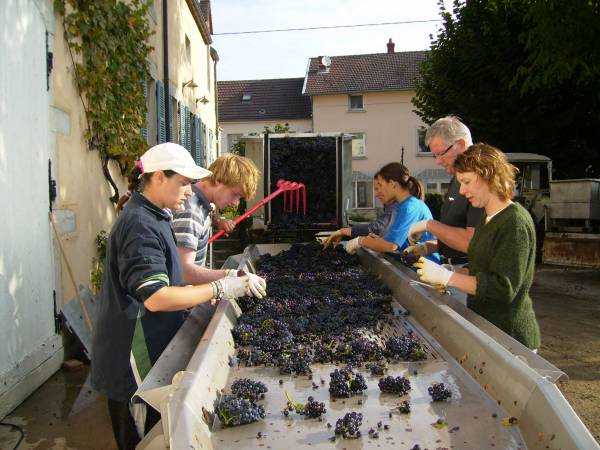
Alot. So how--even in a stellar vintage--do you ensure that the grapes going into the wine are going to be consistently as top-notch as they can be? Like this:
Figure 1. A standard sorting table.
The instructions are simple. As the grapes go by, just remove anything that isn't a grape or a stem. This includes (but is certainly not limited to) leaves, raisins, underripe grapes, botrytized (moldy) bunches, and (whether you want to hear it or not) bugs. (I saved three spiders today from a cold, juicy death.) At first, the work is very demanding of attention. You have to really focus on the grapes, decide what you will and will not allow to roll past, and then act--all rather quickly. I think the conveyor was moving at about 3 inches per second, or a foot every four seconds. That's a pretty good pace. It ain't the "rabbit" on your lawnmower, but it sure ain't the "turtle", either.
After a while, the work does become routine. Your brain starts to relax, and your eyes and hands do the work on their own. You would probably think that these circumstances would be prime for zoning out, for getting a mental breather in, especially after a morning full of high-speed laboratory analysis. That's what I assumed, at least.
Boy, was I wrong.
As it turns out--when you're working at a sorting table for two straight hours, getting no breaks longer than the 15-seconds between bins of fruit being dumped onto the conveyor, understanding absolutely zero of the conversation between your other 5 line workers (middle-aged Mexican women)--your mind wanders. A lot. In the span of those two hours, I had more ideas, insights, and internal dialogs than I've probably had in the last week. At times, I felt like I was high. For example, this thought occurred to me around hour 1.5: This table is such a good metaphor for the arrow of Time, all moving in one direction 'n shit. Or, even better than that one: This table is such a good metaphor for eugenics, all creating a better result by weeding out the weak 'n shit. Alright, maybe that's not so much "high" thinking as it is "hair-brained literary'". But a lot of literature is conceived while high. So.
The most profound thought I had (not to imply that the previous two were) was the realization that, by being on sorting duty, I was as directly involved in the process of making wine as I will probably ever be at Williams Selyem. Sure, determining accurate sugar and acid content in samples is important. Yes, proper yeast culture build-up and inoculation is key. But those are just manipulations of the grapes. By deciding what grapes do or do not make it into the wine, I am directly responsible for the potential that the wine has. I help determine the upper limit of quality. I am both the Gatekeeper and the Keymaster for salvaging an off-vintage, as well as making a good one great.
Figure 2. Gatekeeper (left) and Keymaster (right).
When you think about it, that's some serious responsibility. Not only are the customers going to notice if the final product tastes strange (raisiny, green, etc.), but it affects the company and its reputation. It also affects me. After all, I'm here to make the best damn wines that I possibly can, and to learn how to make them. It'd be nothing short of cognitive dissonance to hold those motivations and not do the best that I could at the sorting table, recognizing the importance of that job.
Therefor, for two hours after lunch today, I sorted grapes like a goddamn champion.
After that, though, I was given the task of pressure washing the entire fermentation pad, so as to prevent the fruit flies and bees from swarming. If I learned anything today, it was this: I pressure wash like a goddamn champion of special needs. Embarrassing as it is to admit it, I suck at pressure washing grape skins and stems from a concrete floor into a drain. Believe it or not (and I have it on good authority that you should), it would actually have taken me less time to pick up every single grape skin individually--with my fingers--than to use a pressure washer. Here's hoping that they don't assign that job to me again.
Figure 3. No pressure washing for Gordon.


 Figure 6. The 6L bottle signed by the Williams Selyem staff, presented